
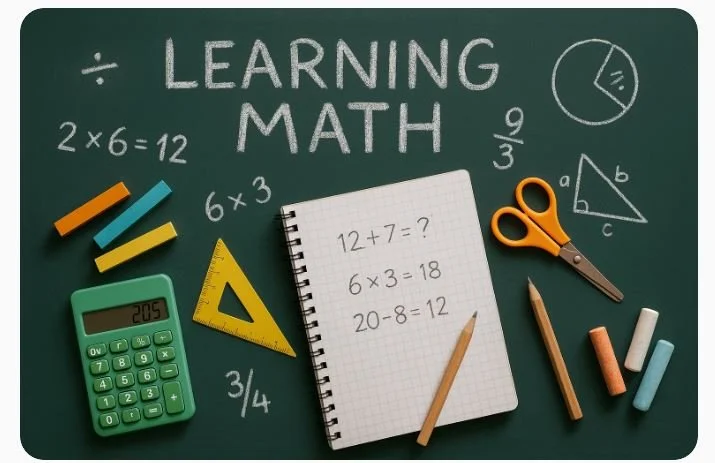
Math (Ages 3 - 11)
Math Skills for Real Life – Available in English & Chinese.
Instructional Approach
This curriculum is designed to build deep mathematical understanding through a coherent and student-centered instructional model:
Concrete → Pictorial → Abstract (CPA):
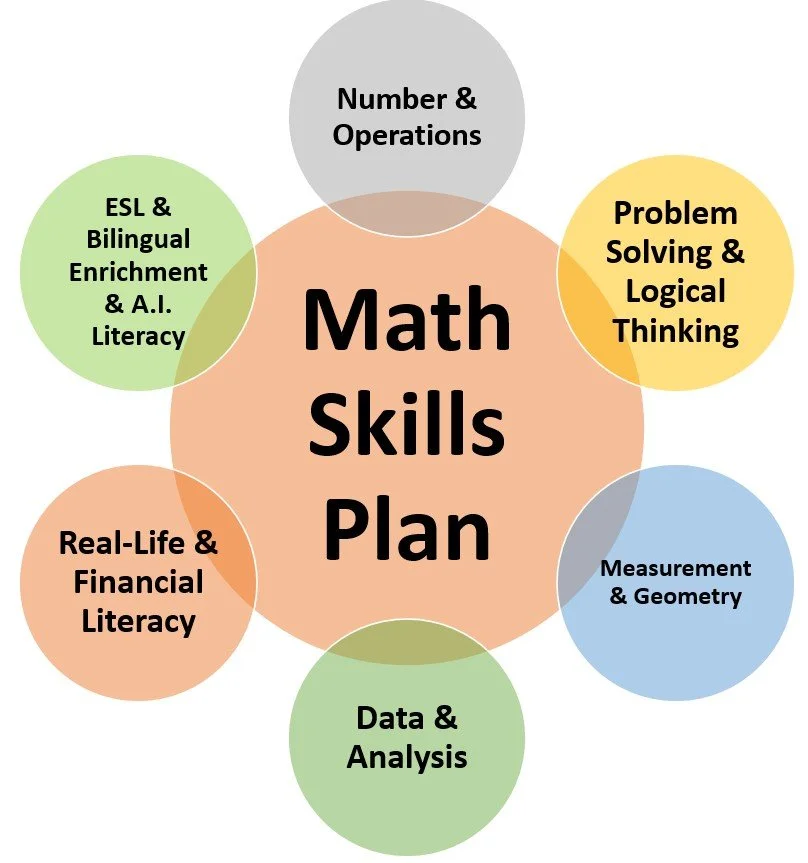
Students progress from hands-on experiences to visual representations, and finally to abstract reasoning, ensuring conceptual understanding at every stage.Real-Life Applications & Project-Based Learning:
Instruction connects mathematics to authentic, real-world contexts, allowing students to apply skills through meaningful projects and problem-solving tasks.Language Development for ESL & Bilingual Learners:
Intentional integration of academic vocabulary and sentence frames supports language acquisition alongside mathematical thinking.AI Literacy Integration:
Students develop responsible and effective use of AI through a structured progression:
Think first → Develop prompt skills → Learn independently.
Core Math Skills
-
Build early mathematical thinking through play, exploration, and hands-on experiences. Students develop number awareness, spatial understanding, and the language of comparison.
-
Develop strong foundational number sense within 20. Students begin composing and decomposing numbers, using models and simple math language to explain thinking.
-
Strengthen addition and subtraction strategies using number bonds, bar models, and mental math. Students move from counting strategies to structured reasoning.
-
Develop fluency with place value and efficient mental strategies. Students apply early multiplication concepts through equal groups and structured models.
-
Build mastery of multiplication, division, and fractions. Students use bar models and arrays to solve word problems and explain reasoning clearly.
-
Solve multi-step problems involving all four operations. Students strengthen fraction understanding, decimals, and geometric reasoning using visual models.
-
Prepare for middle school mathematics through advanced fraction, decimal, and multi-step problem solving. Students develop flexible reasoning and strong analytical thinking.

What Does Each Lesson Look Like?
Preview — Quick preview what we have learned to help the students be clear of the learning objectives.
Learn — Interactive instruction.
Practice — Challenge the students with interactive activities.
Review — Recap and assess the learning results, summarize, arrange homework and provide suggestions.