
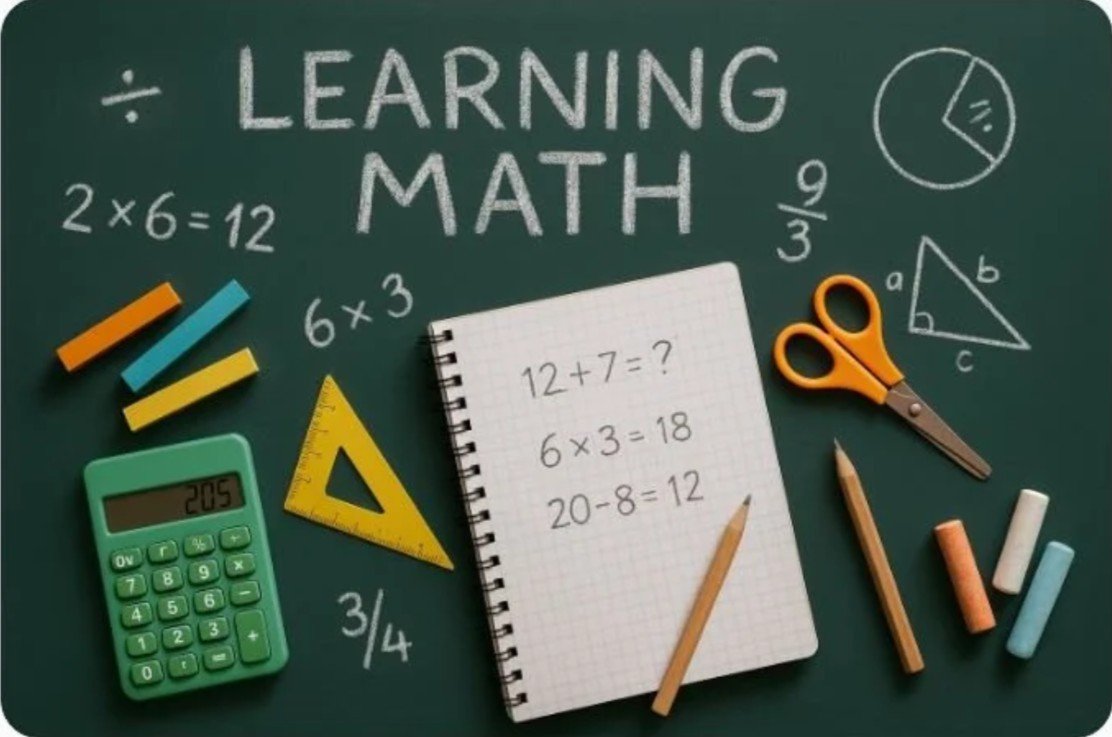

Elementary Academic Math
Online & In-Person (Seattle Eastside)
Math Skills for Real Life – Available in English & Chinese.
Study Skills and Learning Habits (such as note-taking skills)
Foundational Life Skills (such as goal-setting, organization and time-management skills)
Instructional Approach
This curriculum is designed to build deep mathematical understanding through a coherent and student-centered instructional model.
Students are taught based on their academic skill level and learning needs rather than age or school grade alone.
Concrete → Pictorial → Abstract (CPA):
Students progress from hands-on experiences to visual representations, and finally to abstract reasoning, ensuring conceptual understanding at every stage.Real-Life Applications & Project-Based Learning:
Instruction connects mathematics to authentic, real-world contexts, allowing students to apply skills through meaningful projects and problem-solving tasks.Language Development for ESL & Bilingual Learners:
Intentional integration of academic vocabulary and sentence frames supports language acquisition alongside mathematical thinking.AI Literacy Integration:
Students develop responsible and effective use of AI through a structured progression:
Think first → Develop prompt skills → Learn independently.
Tiered Learning Approach
Every student learns differently, so instruction is tailored to meet each child's individual needs, learning pace, and goals.
Tier 1: Catch-Up & Foundation Building
Designed for students who need extra support or have learning gaps.
Focuses on strengthening foundational math skills through clear explanations, guided practice, and targeted instruction.
Helps students build confidence and develop a solid foundation for future success.
Tier 2: Grade-Level Success
Designed for students working at or near grade level.
Aligns with school standards and classroom expectations.
Provides homework support, skill reinforcement, and opportunities to build confidence and mastery.
Tier 3: Advanced & Enrichment
Designed for students who are ready for additional challenge.
Incorporates enrichment programs.
Develops problem-solving abilities, logical reasoning, critical thinking, and deeper mathematical understanding.
Each student's learning path is regularly adjusted to ensure they are challenged, supported, and progressing toward their full potential.
We are available Online and In-Person.
Serving Seattle Eastside: Bellevue, Newcastle, Redmond, Mercer Island, Renton, Kirkland and Issaquah, Sammamish and nearby communities.
Elementary Academic Math
Core Skills We Teach

Elementary Academic Math Overview
Level 1 — Pre-K Academic Level
Build early mathematical thinking through play, exploration, and hands-on experiences. Students develop number awareness, spatial understanding, and the language of comparison.
Level 2 — Kindergarten Academic Level
Develop strong foundational number sense within 20. Students begin composing and decomposing numbers, using models and simple math language to explain thinking.
Level 3 — Grade 1 Academic Level
Strengthen addition and subtraction strategies using number bonds, bar models, and mental math. Students move from counting strategies to structured reasoning.
Level 4 — Grade 2 Academic Level
Develop fluency with place value and efficient mental strategies. Students apply early multiplication concepts through equal groups and structured models.
Level 5 — Grade 3 Academic Level
Build mastery of multiplication, division, and fractions. Students use bar models and arrays to solve word problems and explain reasoning clearly.
Level 6 — Grade 4 Academic Level
Solve multi-step problems involving all four operations. Students strengthen fraction understanding, decimals, and geometric reasoning using visual models.
Level 7 — Grade 5 Academic Level
Prepare for middle school mathematics through advanced fraction, decimal, and multi-step problem solving. Students develop flexible reasoning and strong analytical thinking.
What Does Each Math Lesson Look Like?
Preview — Quick preview what we have learned to help the students be clear of the learning objectives.
Learn — Interactive instruction.
Practice — Challenge the students with interactive activities.
Review— Recap and assess the learning results, summarize, arrange homework and provide suggestions.